Category Archives: Writing

New York Times “Disunion”: Raiding the Keokuk

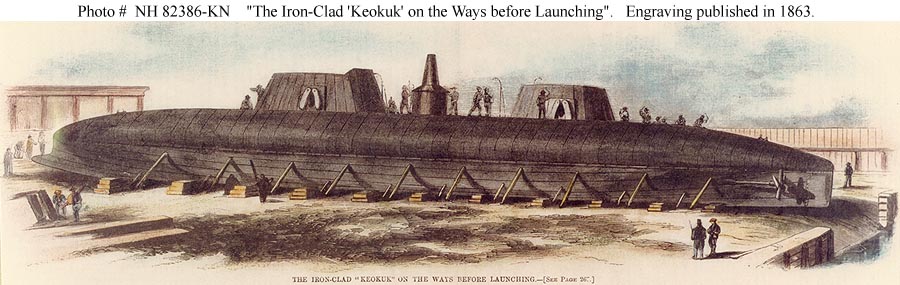
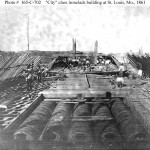
keokukMy third piece for the New York Times “Disunion” series is now online. “Raiding the Keokuk” is about a daring salvage operation of an enemy warship in contested waters. The warship, USS Keokuk, is one of those oddities of technology that really should never have been built. As necessity during wartime can result in brilliant success — i.e. USS Monitor — it can also generate spectacular failures.

I’m really happy with this piece as I was able to get much closer to individuals and a single ship. USS Keokuk, while not a successful design, was a unique looking vessel, and I have a model of her in-progress that I look forward to completing.

Direct link to article HERE.

“Shades of Blue and Gray: Ghosts of the Civil War”

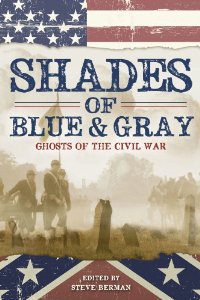
shadesI’m happy to announce that Barnes and Noble and Amazon.com have “Shades of Blue and Gray: Ghosts of the Civil War” up for pre-order, which includes my story “Spectral Drums”.

The full table of contents, which includes many authors I’m proud to be published with, is below:

“Raw Recruits” by Will Ludwigsen
“The Swell of the Cicadas” by Tenea D. Johnson
“Bad Penny” by Carrie Laben
“Spectral Drums” by Devin Poore
“An Occurrence at Owl Creek Bridge” by Ambrose Bierce
“Ten Thousand Miles” by Connie Wilkins
“No More Amongst the Cities of the Earth” by Christopher M. Cevasco
The Country House” by Jameson Currier
“An Unclean Thing” by Cindy Potts
“The Blank Flag of Arthur Kerry” by Kristopher Reisz
“Three Silent Things” by John F. D. Taff
“Across Hickman’s Bridge to Home” by Russell Davis
“Mistress” by Jennifer R. Povey
“Tommy Cleburne” by Jeff Mann
“The Overseer” by Albert E. Cowdrey
“Red Animal” by Ed Kurtz
“Proving Up” by Caren Gussoff
“Vermont Muster” by Nick Mamatas
“Like Quicksilver for Gold” by Chaz Brenchley
“The Beatification of Custer Poe” by Laird Barron
“The Arabella” by Melissa Scott
“The Third Nation” by Lee Hoffman

New York Times “Disunion”: Rise of the Infernal Machines

cushing

My second piece for the Times’ “Disunion” web series has been published. “Rise of the Infernal Machines” gives an overview of the torpedoes of the day, what we now mostly know as mines. Crude, unstable, and mostly non-functional, they provided the Confederacy with a new weapon with which to strike back at the superior Union navy. Despite their endless problems, they succeeded in sinking more Union warships than all other means combined (probably speaking more to the ineffectiveness of Confederate warships and fortifications than to effectiveness of the torpedoes). The article can be access HERE.

New York Times “Disunion” Piece Published

city buildingVery happy to announce that the New York Times has published my first piece for their website. Ironclad Fever is about the armored warship building frenzy in both North and South after the Monitor and Virginia (Merrimack) battle in 1862.

I’m extremely pleased to be able to put all of the historical research I’ve done while building models and writing stories into this format.

Giving it the sidelong glance

I recently acquired a copy of Ken Rand’s “The 10% Solution” and ran a couple of pieces of writing through the process. The premise is simple: nearly everyone can run through a piece of work and cut it by 10%,  in the process making it sharper, more concise, and easier to understand.

The first revelation is that I had no idea how often I use “of” in my writing. I mean a lot. A whole bunch of “ofs”. That and the always prevalent “and”, “was”, and “were” jumped out at me as I ran through the process in the book. The interesting bit came when the process didn’t simply result in deleting words, but recasting entire sentences and paragraphs when those issues are called to attention, and how the resulting product is so much the better.

I’ve always taken the “walk away” approach to writing and other projects — Continue reading

Battle of Brawner Farm: August 28, 1862

Yesterday evening, August 28th, I sat on our deck in Hoboken, New Jersey, right before sunset. I watched the sun sink below the horizon and thought about what was kicking off down in Virginia, 150 years ago. The battle at Brawner Farm began just before sunset, at about 6 p.m. in 1862, but now with time zones and other factors, it was nearly 8 p.m. here by the time the sky had turned to a gradient of orange upwards to dark blue, and everyday objects replaced their hard lines with shadows.

Brawner Farm was the first battle for the Union unit known as The Iron Brigade, a unit I’ve developed a particular fondness for. They didn’t have that name 150 years ago at Brawner Farm, though, not yet.  They’d earn that at the battle of South Mountain in less than a month. On August 28th, they were known as the Black Hats. The unit was made up of entirely “western” soldiers, men from Wisconsin and Indiana; the only brigade in the eastern theater to be made up so. In order to further distinguish them, their commander John Gibbon outfit them in the regular army uniform of tall black hats, long blue frock coats, and even dress leggings. Imagine going into battle wearing that.

The unit was formed in late 1861, Continue reading

Appliance Poetry

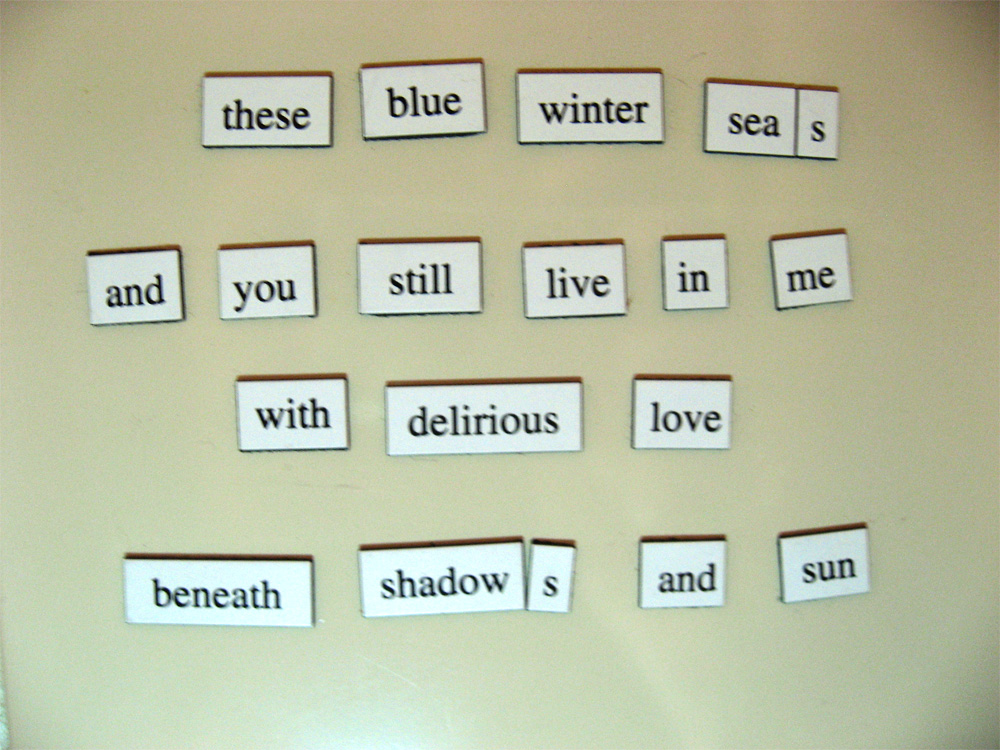
A couple of weeks ago we replaced our old refrigerator with a brand new shiny one. Before the delivery men carted the old one away, I took the above photo of its side.

Nearly fourteen years ago (holy crap, that’s a long time!) I first met my wife at a party at her place, which is now our place. As part of my attempt to woo her, I turned to the ever popular magnetic poetry set on the refrigerator. Considering the limited word palette, I don’t think I did too bad. The poem stayed on the ‘fridge all of those years, and now the words lay in a pile on my desk, as I think of something cool to do with them.


Hour of the Wolf Appearance

Recently the Altered Fluid writing group appeared on the Hour of the Wolf on WBAI. This time it was I who was on the chopping block with a new short story. The story, very tentatively titled, Number Thirty-Five, was a very rough draft. I had considered turning in something that I’d worked a little bit more on, but I went ahead with the rough piece. It turns out it was a good choice, as this time the show was a bit different as well. We recorded the critiques at a meeting in September, and did the radio show 4 months later. This allowed us to discuss the story as it was critiqued, and also gave us the chance to talk about some of the changes that have come about in edits. Since recording the show i have continued to work on the story, inspired by the conversations that night, and hope to have it ready to submit to a market or two in the near future.

** EDIT **WordPress is being screwy with the link I posted.  Copy and past the below into your browser and it’ll bring up the MP3 of the show: